

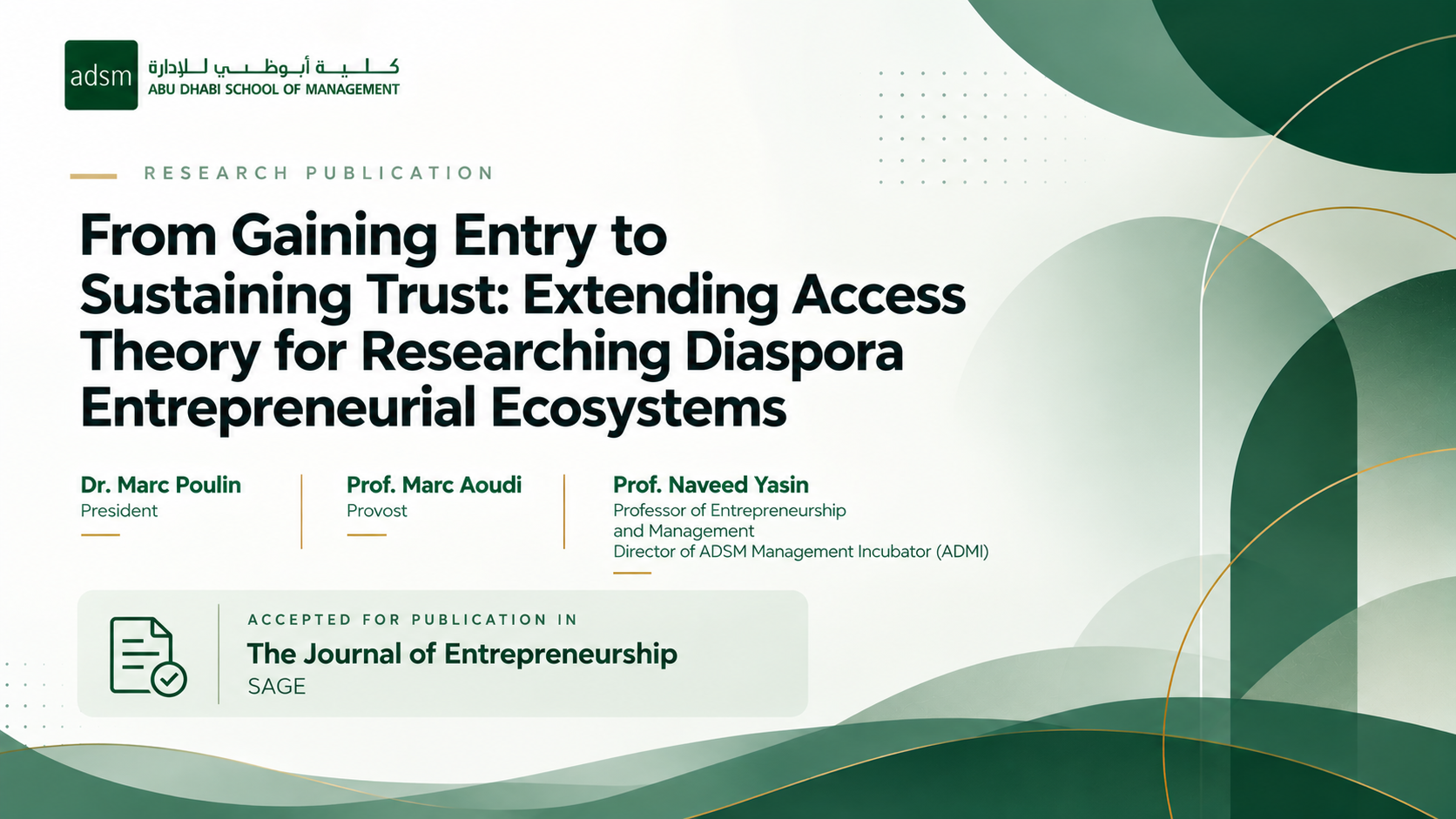
A paper co-authored by three scholars from Abu Dhabi School of Management (ADSM), Professor Naveed Yasin, Dr Marc Poulin and Professor Marc Aoudi, has been accepted for publication in The Journal of Entrepreneurship, published by SAGE.
Titled “From Gaining Entry to Sustaining Trust: Extending Access Theory for Researching Diaspora Entrepreneurial Ecosystems,” the paper will appear in the special issue “Entrepreneurial Ecosystems through a Diaspora Lens: Social, Cultural, Political, and Psychological Influences on Entrepreneurship.” It is scheduled for Volume 35, Number 4, in November 2026, with online publication expected beforehand.
The paper makes a methodological contribution to qualitative entrepreneurship research by examining how research access shapes the knowledge scholars produce. Its central argument is that gaining permission to enter a community or securing an interview does not necessarily enable researchers to understand participants’ experiences and meanings.
To explain this distinction, the authors develop the concept of epistemic access, a framework comprising four interrelated dimensions. Relational access concerns the trust that enables participants to disclose their experiences. Cultural access concerns the contextual understanding needed to interpret those accounts. Linguistic access addresses how meanings are communicated, translated and preserved across languages. Ethical access concerns the legitimacy, reciprocity and accountability involved in representing participants’ lives.
The framework is particularly relevant to diaspora entrepreneurial ecosystems, where business activity is shaped by family relationships, community networks, cultural obligations, multilingual communication and connections across countries. These conditions influence both entrepreneurial activity and researchers’ ability to understand it.
The paper also examines the limits of close research relationships. Sustained engagement can support richer understanding, but strong community ties may create pressures that restrict critical interpretation. The authors therefore emphasise the importance of combining meaningful access with reflexivity and analytical distance.
By connecting access theory with qualitative knowledge production, the paper offers researchers a framework for examining what participants disclose, how their accounts are interpreted and how entrepreneurial experiences are represented. Its acceptance adds to ADSM’s research in entrepreneurship and qualitative methodology through collaboration among its scholars and international co-authors
